
BIO 2019
The University of Queensland – ranked
7th globally for biotechnology


From agriculture and biotechnology to science and sustainability, UQ research has impact – right across the world, every day.

The University of Queensland specialises in research that creates meaningful impact.
UQ continually builds on its global reputation in key areas of national and international significance through interdisciplinary collaboration with more than 400 international industry partners.
UQ’s world-leading research is delivered by an interdisciplinary research community of more than 1500 scientists across our six faculties, eight research institutes and 100+ research centres.
Explore our capabilities below, or get in touch to discuss how we can work with you.
Areas of expertise


Fast facts

Global top 50 University

200+ active licence agreements

US$20 billion gross product sales

100+ companies created

87 granted US patents

400+ institutional partners in 50+ countries

#1 Australian institution for life sciences
(Nature Index 2017)

8 world-leading research institutes

100% of UQ research at or above world standard
(ERA Assessment 2015)
Facilities


Centre for Microscopy and Microanalysis
The Centre provides a comprehensive suite of analytical instrumentation and a high standard of training programs as well as specialist staff who provide expert advice to clients to help them to achieve their research goals. Instrumentation includes state of the art transmission electron microscopes, scanning electron microscopes, electron beam lithography and X-Ray Fluorescence instrumentation as well as a Remote Operation Crystallization and X-ray Diffraction Facility.

Australian National Fabrication Facility (ANFF)
ANFF’s Queensland Node (ANFF-Q) is a state-of-the-art fabrication facility specialising in microfluidics, organic electronics and opto-electronics, biomaterials, novel semiconductor materials and characterisation. In addition to providing access to advanced instrumentation and providing world class training, ANFF-Q’s highly experienced Professional Officers can be engaged to perform contract R&D, fabrication, characterisation or consulting services.

Centre for Advanced Imaging
As a leading imaging research facility in Australia, the Centre for Advanced Imaging manages the most comprehensive range of magnetic resonance instrumentation in the southern hemisphere, including three whole body scanners, several High Resolution Nuclear Magnetic Resonance spectrometers, solid states and Electron Paramagnetic Resonance instruments and microimaging and animal imaging systems.

Protein Expression Facility
The UQ Protein Expression Facility (PEF) is Australia’s leading protein research facility with an excellent track record that specialises in recombinant protein production for both academic and industry researchers. PEF incorporates state-of-the-art facilities and a team of highly skilled research specialists that possess extensive knowledge and expertise in protein expression and purification.

TetraQ
TetraQ is a National Association of Testing Authorities accredited, Good Laboratory Practice recognised facility, with over 10 years in operation developing and validating bioanalytical methods to determine drug concentrations in a variety of matrices and conducting sample analysis in support of clinical and preclinical trials and has GLP recognition for the conduct of both in vitro and in vivo toxicology services and has experience in undertaking complete preclinical study packages for inclusion in investigational new drug applications (INDs). TetraQ conducts in house pharmacokinetic analysis these studies tailored to suit the stage of development you are at and include common PK parameters.


Case Studies


UQ engages globally with more than 400 industry partners – together, we are creating real change with meaningful impact.
Health
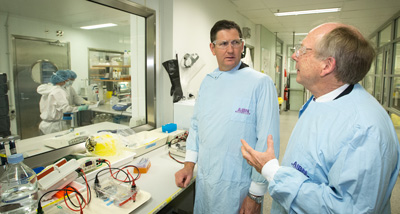
Biomanufacturing Hendra antibodies
In Queensland in September, 1994 the very first outbreak of Hendra virus occurred. Within a matter of days one human and thirteen infected horses had died. By 2009, four people along with numerous horses had died after contracting Hendra, and more outbreaks were on their way. Scientists at the National Biologics Facility at UQ’s AIBN developed a bioprocess to produce clinical amounts of an antibody developed in the US that blocked entry of the virus to human cells, allowing the immune system to fight off the virus. Production of the antibody for emergency compassionate use has since continued and, to date, the antibody has been administered to more than 10 people, who had high risk exposure to Hendra virus. None developed the illness. The NBF have also enabled a recently- completed phase I clinical trial
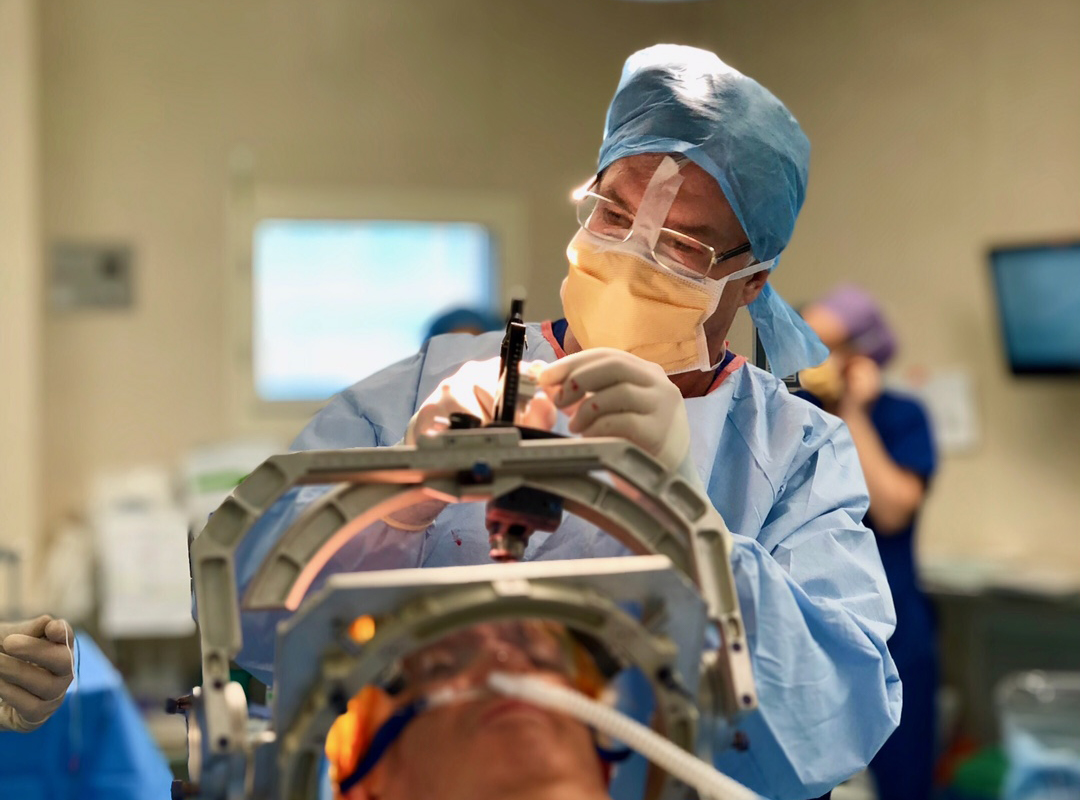
Deep Brain Stimulation
Queensland Brain Institute’s Asia Pacific Centre for Neuromodulation is home to one of the world’s leading deep brain stimulation (DBS) teams who recently reached their 1000th case milestone. DBS is an effective treatment for several neurological conditions and holds great promise to treat a variety of other brain disorders. For example, QBI is currently working with industry and hospital partners to conduct clinical trials in DBS for anorexia and obsessive-compulsive disorder. To complement and capitalise on its access to world-class neurosurgical expertise, QBI is strengthening its research capabilities and enhancing its capacity to conduct clinical trials. This has recently led to partnerships with the Southern University of Science and Technology and with Bao’an District Hospital, both located in Shenzhen, China.

Ultrasound
In 2015 Queensland Brain Institute researchers showed that scanning ultrasound could, via its effects on the blood–brain barrier, deliver therapeutic effects in a mouse model of Alzheimer’s disease. Subsequent work showed that the same approach could also enhance delivery of an immunotherapeutic agent to its neural target, a longstanding challenge in addressing brain disorders. Working with industry partners to scale up these efforts, the team created a prototype device that could effectively open the blood–brain barrier in sheep, which have thick, dense skulls more similar to those of humans. First-in-human safety trials are anticipated in late 2019/2020.
Agriculture

Bioclay – sustainable crop protection spray
Crop viruses and pests reduce global food production by a massive 20 to 40 per cent. UQ scientists have developed BioClay - an agricultural nanotechnology innovation, to help reduce food production losses from pests and pathogens, without the toxic environmental impacts of current chemical sprays.

Novel plant propagation techniques
To boost production of horticulture crops such as avocado, UQ researchers are combining microscopic tissue culture cuttings with new plant propagation techniques to produce hundreds of plants from a single cutting ready for planting in 12 months.

Speed breeding
To minimise the impacts of drought and climate change on crops, UQ researchers are speeding up the life cycle of crops to develop more resilient crop varieties. This world-first speed breeding technique, uses light and temperature controlled greenhouses to accelerate plant growth and deliver more tolerant crops varieties. This technology is being shared with Asian and African nations.
UQ Startup companies

Dendright Pty Ltd
Dendright’s tolerising immunotherapy re-educates the body’s immune response to fight rheumatoid arthritis – a debilitating autoimmune disease that affects 23 million sufferers worldwide, destroying joints and causing cardiovascular complications that can reduce lifespan by 10 years. The company is commercialising research from UQ’s Diamantina Institute based on the discovery that the body’s immune response can be ‘re-educated’ to turn off, rather than react to a self-antigen responsible for an autoimmune disease. By targeting the cause, rather than treating the symptoms, this type of immunotherapy offers the potential for long-lasting treatment by working with the body’s own immune system to fight disease.

Inflazome Ltd
Inflazome was founded in 2016 to develop drugs for inflammatory diseases and is based on research from UQ’s Institute for Molecular Bioscience and Trinity College Dublin in Ireland. Inflazome is developing drugs to address clinical unmet needs in inflammatory diseases by targeting the NLRP3 inflammasome, which is now understood to drive many chronic inflammatory conditions. In 2018, it secured A$63 million in Series B financing to advance its small-molecule inhibitors of the NLRP3 inflammasome into multiple clinical trials in 2019. Headquartered in Dublin, Ireland, the company received US$1 million to support the development of a brain imaging probe for patient diagnosis and the clinical development of drugs to treat neurodegenerative diseases from the Michael J. Fox Foundation for Parkinson’s Research in March, 2019.

NuNerve Pty Ltd
Researchers from the Queensland Brain Institute have shown that blocking the actions of the EphA4 molecule in animal models could improve motor neuron recovery after injury. This finding has implications for Motor Neurone Disease (MND), a neurodegenerative condition that causes irreversible loss of the nerve cells controlling our muscles. Working with Mr Goodenough’s Trust, UniQuest established spin-out company NuNerve in 2009 to develop a drug candidate that blocks the EphA4 molecule. NuNerve is now partnering with biologics manufacturer Patheon to industrialise production of the drug candidate, with clinical trials anticipated in 2019.

Protagonist Therapeutics Inc
Overcoming the need to deliver peptide therapeutics by needle and syringe has been at the core of biotechnology company Protagonist Therapeutics for more than 15 years. Since its inception at The University of Queensland’s Institute for Molecular Bioscience, Protagonist has focused its expertise on developing oral drugs for known drug targets and diseases that currently require treatments to be injected. Since it was founded in 2001, Protagonist has raised a total of A$88 million in private funding, including A$40 million Series C financing lead by Canaan Partners in July, 2015. Protagonist initiated a Phase 1 clinical trial in 2016 for its lead compound: A novel, orally stable peptide therapeutic for inflammatory bowel disease. The company was listed on the NASDAQ stock market that same year, raising $US90 million in its initial public offering of 7.5 million shares.

QUE Oncology Inc
Clinical-stage biotechnology company QUE Oncology was jointly established in 2013 by UniQuest, the University of Queensland’s commercialisation company, and Emory University, based in the United States. QUE Oncology licensed intellectual property from research at both UQ and Emory University to develop novel therapies to address unmet medical needs and treat the side-effects of cancer therapy. In 2017, QUE Oncology raised A$21.5 million in series A investment from the Brandon Capital-managed Medical Research Commercialisation Fund and Uniseed. The investment was to facilitate the further development of its leading drug candidate, Q-122. Q-122 is an oral, non-hormonal drug candidate designed to treat hot flushes in breast cancer survivors undergoing hormone therapy. A dose-defining Phase II study of 130 women in Australia and the US, commenced in 2018.

Vaxxas Pty Ltd
Vaxxas is commercialising a novel vaccine delivery platform developed at UQ’s Australian Institute for Bioengineering and Nanotechnology that enables smaller doses of vaccines to be safely and effectively delivered, without the use of needles. Application of the Nanopatch™ to the skin is pain-free and can eliminate the need for refrigeration during storage and transportation. Vaxxas was established as a UQ startup company in 2011 after UniQuest secured funding from a syndicate of investors who committed $15 million to advance the Nanopatch™ technology to clinical trials. The company raised A$25 million in Series B Venture Financing to accelerate the commercialisation of the platform in 2015 and has secured funding from the World Health Organisation to evaluate Nanopatch™ for polio vaccination.
Get in touch
UQ’s world-leading research is delivered by an interdisciplinary research community of more than 1500 scientists across our six faculties, eight research institutes and 100+ research centres.
Explore our specific capabilities
- Australian Institute for Bioengineering and Nanotechnology
- Faculty of Science
- Institute for Molecular Bioscience
- Queensland Alliance for Agriculture and Food Innovation
- Queensland Brain Institute
- Queensland Emory Drug Discovery Initiative
- UniQuest
Get in touch to discuss your project and partner with us
Email: researchpartnerships@research.uq.edu.au
Phone: +61 412 356 199 / +61 437 399 554


 Built with Shorthand